
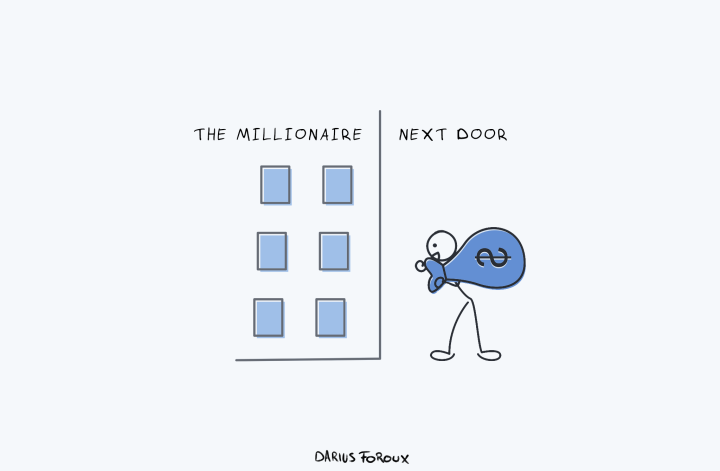
5 Steps to Become a “Millionaire Next Door”

Millionaire Next Door

When researcher Thomas Stanley tried to learn how people became wealthy, he started by visiting upscale neighborhoods across America.

He discovered that many people who lived in expensive homes didn’t have much wealth. Instead, each millionaire he found didn’t look like a millionaire.

  • They lived in middle-class neighborhoods, instead of “upscale addresses”
  • They didn’t own the latest model cars or expensive watches
  • They didn’t wear luxury clothing brands
  • and so forth.

Stanley also expected most wealthy people to be descendants of old-money families, like the Rockefellers and Vanderbilts. But that wasn’t the case. Instead, he found ordinary people who built their wealth by themselves, in one generation.

His insights led him to write the bestselling book, The Millionaire Next Door. The book’s findings were simple but powerful:

“We discovered who the wealthy really are and who they are not. And, most important, we have determined how ordinary people can become wealthy.”

A lot of people confuse wealth with income. Wealth is not income. Even if you have a high income, spending it all means you won’t get wealthy. It’s all about living a fulfilling lifestyle you want below your means.

I used to have goals like, “I’d like to make a million dollars a year!” But that’s too dependent on outcomes. It gets you trapped in a cycle of chasing after more and more. And more money doesn’t lead to financial independence.

Here are the 5 steps you can take to build wealth and eventually become a “millionaire next door.”

Continue Reading

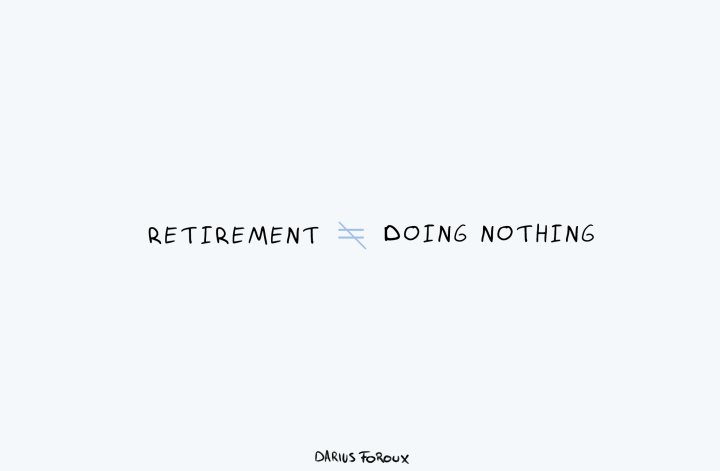
It’s Time to Rethink Retirement

retirement

Here’s what the structure of modern life looks like for most. In the early years of a child, the focus is on learning and playing.

Once the playing is done, a teen starts their educational career. Then start a career. And save up for retirement. Those are the three main stages of life as we know it: Study, work, then retire.

It might look like these stages are natural to human life, but that’s a wrong assumption. These stages are, like most things in modern-life, made up.

This structure was created in the 19th century, when the Prussian statesman Otto von Bismarck implemented the first national old-age social insurance plan in 1889.

At the time, the world was going through the industrial revolution, and sending your kids off to school was just starting to become the norm. Bismarck’s government was trying to give more jobs to the unemployed youth by retiring workers aged 70 and above.

Continue Reading

“Nothing Will Last” Forecasting Technique: Anticipate the Future

predict-the-future

I enjoy reading books that forecast the future and give you insights. One of the best books I’ve read on this topic is The Sovereign Individual by Davidson and Reese-Mogg.

The book is from 1999 and is about how we can adapt and prepare for the information age. Their forecast of what the future of our economy would look like was highly accurate.

They analyzed exciting trends and combined them with their vision of the future to make their forecast. They assumed that individuals would have more freedom and control over their financial situation.

Continue Reading

What Would You Do if You Were Rich?

if-you-were-rich

Let’s do a thought experiment. I did this several years ago and it changed my idea of being rich and the overall pursuit of wealth.

I got it from an old post by the blogger, Mr. Money Mustache. In the article, he says he would do “absolutely nothing differently,” if he had more money. When I read that for the first time, I thought, “yeah right.”

Back then, I was out of grad school for a year, was in debt, had recently started a business, paid myself about $15,000 in salary, and did not have any savings like Mustache. I was desperately trying to earn more money so I could have more freedom… But to do what with that money and freedom?

That was something I didn’t figure out for years. But I’m glad I kept thinking about this concept of “what would you do if you had more money?” It helped me to avoid chasing money too much. 

As I started to build my career and began to earn more, I realized that you don’t have to make a mistake to learn a lesson. You don’t always need to learn things “the hard way.” You can think things through. 

Take a concept like this one. How many of us assume we need to have more money to be happy? And the one important habit I learned over time is to question everything.

Continue Reading