7 Things Rich People Never Do

7 Things Rich People Never Do

I’ve adopted the mental model of Charlie Munger when it comes to living a good life. It’s useful to gain insights into the thought process of certain rich people.

Munger was trained as a lawyer, got briefly into real estate development, and built his fortune together with Warren Buffett in Berkshire Hathaway. Munger says:

“My system in life is to figure out what’s really stupid and then avoid it. It doesn’t make me popular, but it prevents a lot of trouble.”

It’s attractive to talk about all the things rich people do and how you can build wealth. A large part of my work focuses on the right actions we should undertake to get wealthy.

But what I don’t always share is how I figured out the right actions. Most of the time it’s a matter of looking at the wrong options and doing the opposite. In this article, I’m sharing 7 things that you want to avoid if you want to get rich. 

Continue Reading

Money Fallacy #1: The Checks Will Not Always Come

Consider two artists: MC Hammer and Chamillionaire. Most people know the former because he famously went broke in the 90s despite earning millions of dollars. It’s a good case of money fallacy that many people who earn well often ignore.

MC Hammer made 37 million dollars. But he spent 50. And when he declared bankruptcy in 1996, he had 13 million dollars of debt.

Now, look at Chamillionaire, who just like Hammer, was popular for a few years. When I was in college, he had a famous song called Ridin Dirty. I was never a fan and never heard about Chamillionaire again until a few years ago.

I read that used the money he made during those few years he was popular to invest. Now, he’s worth at least 50 million dollars.

Continue Reading

5 “Counterintuitive” Life Lessons I Learned from 5 Books

Counterintuitive Life Lessons

Many things in life are the exact opposite of what we assume they are. For example, when it comes to personal productivity, we often think we need to work harder and do more to achieve more. That’s where counterintuitive life lessons come in.

More often than not, we need to do less. We need to narrow our focus. 

In this article, I’ve summarized 5 of the most important counterintuitive lessons I’ve learned about different important life topics, running from achievement to mental health.

Continue Reading

Why Too Much Efficiency Kills Your Creativity

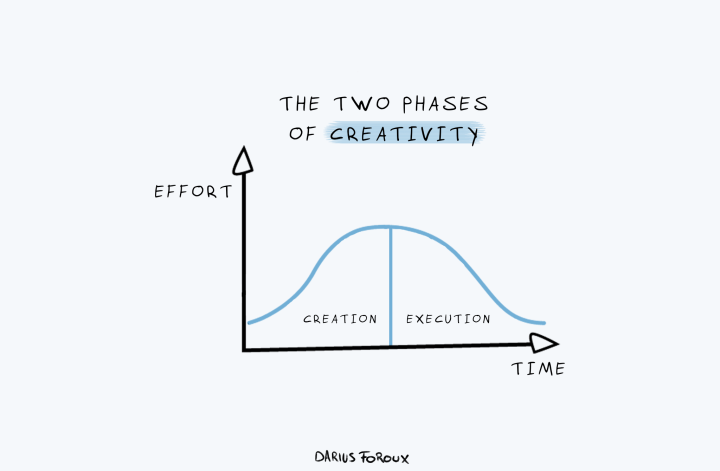
Two Phases of Creativity

Creativity isn’t something that only “creatives” need. Anyone who creates useful ideas is always in high demand.

And in our services-dominated economy, we need to be creative to succeed.

  • Sharing a helpful idea during a work meeting
  • Making your pitch unique for a client
  • Creating “original” art
  • and so forth

Netflix is a great example of being competitively creative in today’s high-paced world.

In the early 2000s, Netflix was a struggling DVD-rental subscription service with little creativity. Netflix co-founder Reed Hastings tried to cut his losses by selling the business to Blockbuster, then a major video and game rental store. But Blockbuster declined.

With the country going through a recession, Hastings had to lay off 30% of his staff.

This forced him to rethink things. If Netflix were to survive, it had to be creative and think of new ideas. It wasn’t just about efficiency anymore. They had to do everything differently.

In an interview1Source: L.A. Times, Hastings looked back at some of Netflix’s low points. And he reflected:

“If you think of the last 300 years, we’ve had factories providing enormous economic value, and so a lot of our society has the factory as the model of the organization. Very top-down, very process, very efficient.

But it’s not the right way to run a creative organization. An organization that needs new ideas needs to be able to make mistakes.”

Nowadays, productivity books and blogs are everywhere (you’re reading one right now). This shows how much people want to live a productive lifestyle. But we can also overdo it.

Continue Reading