In January 2015, I don’t think I got a single good night of sleep.
My grandmother had been in the hospital while I was away on a New Year’s vacation with my girlfriend at the time. My family back home hadn’t told me how serious the situation was. After my grandmother passed away, my mind kept going back to the same question:
What if I hadn’t gone on that vacation?
The relationship wasn’t in a good place either. So that created a new set of questions. What if I had ended it earlier? What if I stayed? What if I ended up alone?
My job also felt wrong. I was dealing with a teammate who was backstabbing me, and I kept thinking: What if I had seen it earlier? What if I quit? What would a hole in my résumé do to my career?
And then my mind moved further into the future.
What if I keep living like this? Where will I end up?
One thought created another. The past gave me regret, the future gave me fear, and the present disappeared somewhere in between.
I remember thinking: There must be a better way of dealing with your thoughts. This can’t be it. This is no way to live.
There is a better way.
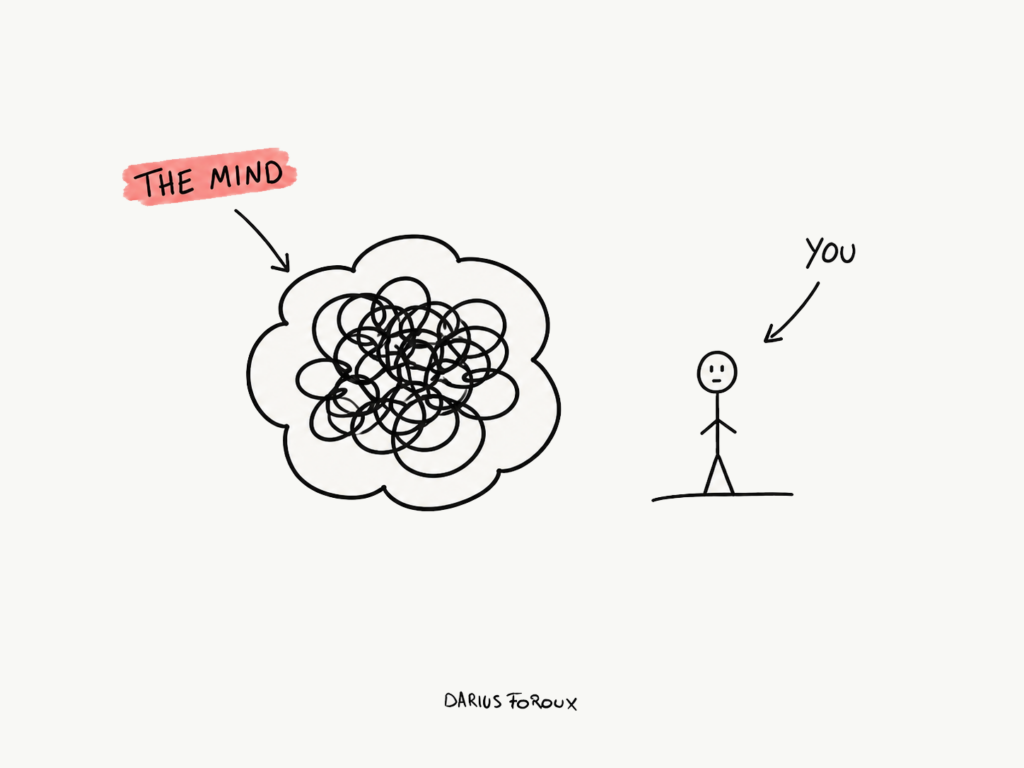
You stop assuming that every thought is true, important, or worthy of your attention. You learn to observe what your mind produces without immediately becoming part of it.
That’s the main idea I want to share with you: You have a mind, but you are not every thought that appears in it.
Your mind will create fear, memories, plans, judgments, fantasies, and worst-case scenarios all day. You can’t stop every thought from appearing. But you can decide whether you will follow it.
That small space between noticing a thought and following it can change your life.
Your mind keeps offering stories
A thought often feels like reality because it appears in your own voice:
- You should’ve known better.
- This will probably go wrong.
- You’re falling behind.
- What if you never find another job or relationship?
The mind says these things with confidence. And when you don’t create any distance, you start living according to them. You delay a decision, stay in a situation that doesn’t work, lose sleep, or mentally replay something that can’t be changed.
But where did the thought come from? Did you choose it? Did you carefully examine the facts and reach a conclusion?
Usually, no. It simply appeared.
This doesn’t mean you should ignore your mind. Some thoughts are useful. They point to a real problem, help you make a decision, or show you what needs to change.
The goal is to stop treating every thought the same way.
When you notice yourself drifting into another loop, ask:
Is this thought useful?
If it helps you solve a problem or take action, use it. If it only creates another hour of worry, let it pass and return to what you’re doing.
That’s what I meant when I wrote Stop Spending So Much Time in Your Head in 2016. Your mind is a tool. It should help you live. You shouldn’t spend your whole life trapped inside it.
What did the Stoics understand about thoughts?
I knew a little about Stoicism and mindfulness in 2015. I had read about those ideas, but I hadn’t studied them deeply and I certainly wasn’t applying them consistently.
Epictetus wrote this in The Enchiridion:
“Men are disturbed not by things, but by the views which they take of things.”
That line doesn’t mean painful events are imaginary. Loss hurts. Betrayal hurts. Uncertainty can keep you awake.
But the mind often adds a second layer. Something happens, and then you create ten stories about what it means, what should’ve happened, and what might happen next.
That was exactly what I was doing in January 2015. I was dealing with real pain, but I also kept feeding it with one what if after another.
The Stoics trained themselves to examine what they called impressions. A thought, feeling, or first reaction could appear without permission. Their responsibility was to decide whether they agreed with it.
You can do the same. When your mind says, “Everything is going wrong,” you don’t have to argue for an hour. Pause and look at the thought.
Is everything going wrong? Or are two parts of your life difficult right now?
That question gives you perspective.
Pain finally forced me to change
I believe change often comes from pain.
If your job is okay, you can stay there for years. You’re not happy, but you can deal with it. If a relationship isn’t good but also isn’t terrible, you keep postponing the decision. You tell yourself it will probably get better.
That middle position is dangerous because you can tolerate it.
But sometimes several things come together. You experience a loss, your relationship ends, work becomes unbearable, or you get fired. The pain becomes too large to ignore, and it forces you to move.
That’s what happened to me. Everything came together, and I reached a point where I felt I had nothing to lose. I thought, Screw everything. I’m going to quit my job, move back in with my parents, and rebuild myself from the beginning.
And that’s what I did.
Observing your thoughts doesn’t mean you become passive. Sometimes you notice that the same thought keeps returning because you refuse to deal with a real problem.
The skill is knowing the difference between a useless loop and a message that requires action.
“What if I ruin my career?” kept me frozen. “This job and life no longer work for me” helped me make a decision.
One created more fear; The other gave me a direction.
How do you create distance from your thoughts?
Understanding this idea helps, but you need to practice it. I use a few different ways to maintain that distance.
Write down what’s in your mind
Journaling has been one of my most useful practices because a thought changes when you put it on paper. You can see what you’re saying instead of hearing the same sentence repeat in your head.
Write the thought exactly as it appears. Then ask:
- Is this true?
- Is it within my control?
- Does it require action?
- What’s the next thing I can do?
You’ll often notice that the thought is vague. “My career is going nowhere” feels enormous. “I need to have a conversation with my manager” gives you something concrete to do.
Practice awareness during ordinary moments
Mindfulness doesn’t have to mean sitting cross-legged for an hour. You can practice while walking, working, eating, or talking to someone.
Notice when your attention leaves the present. Then return to what’s in front of you. Feel your feet while you walk. Listen to the person who is talking. Read the sentence on the screen instead of thinking about tomorrow.
The practice is the return. You will drift again. Fine. Notice it and return again.
Use meditation if it works for you
Meditation is one way to train awareness, but it isn’t the only way. I’ve tried it during different periods of my life, and it hasn’t always worked well for me.
Maybe you benefit from ten minutes of sitting quietly. Maybe you get the same distance through journaling, exercise, a long walk, or simply doing one thing without your phone.
Use the practice that helps you observe without getting pulled into every thought.
Act when the thought points to reality
You can’t journal your way out of every problem. If you’re in the wrong job, relationship, or environment, awareness should eventually lead to a decision.
Don’t use mindfulness to tolerate a life you know you need to change.
First observe, then decide, then act.
You never fully master your mind
It’s now about 11 and a half years since that period in 2015. I’ve spent those years writing about practical philosophy, thinking, mindfulness, and Stoicism. And I still don’t feel like I’ve mastered my mind.
I don’t think there will ever be a point when the training is finished.
Your mind keeps playing tricks on you. It pulls you toward fear, regret, distraction, and chaos. When you stop paying attention, you slowly lose the distance you worked to create.
The same thing happens with your health. You can be in excellent shape, but if you stop moving and stop watching what you eat, your condition changes. You don’t get to keep fitness forever because you trained hard ten years ago.
Mental awareness works the same way. If you stop journaling, reflecting, or practicing mindfulness, you become more likely to get lost in your thoughts again. You forget that you’re observing the mind and start believing the illusion that every thought is you.
So keep training. The next time your mind starts another chain of what ifs, don’t try to answer every question. Notice what’s happening and ask whether the thought is useful.
If it points to an action, take it. If it only pulls you further away from reality, come back to the life in front of you.
You will have to do that for the rest of your life.
And that’s fine.
All the best.
-Darius