Last week I was walking through town with my wife and our son in the stroller. We ran into a former high school classmate. We were both pleasantly surprised to see each other after so many years.
He looked at my wife and said: “He was always the cool guy in school.”
I laughed because it reminded me how much I cared about how I looked and what people thought of me back then.
For a sixteen-year-old, that’s probably normal. But at some point, you’ve got to stop living like that.
The thing is, most people don’t actually stop. They just trade one obsession for another.
From cool-obsessed to money-obsessed
When I was at university, a friend of my father, a very successful businessman, asked me what I wanted to do after graduation.
“Work at a bank,” I said, “and eventually become CEO.”
I wasn’t joking. I was always obsessed with finance and had been reading about CEO compensation at major banks. The numbers were insane, and I thought: That’s the goal!
I had no idea what that actually required. Decades of grinding. Office politics, luck, compromise.
I just saw the number and decided that was what success looked like. Looking back, I find that pretty embarrassing. But that’s where my head was.
So I did everything I thought would make me rich. I started a business with my dad.
When that didn’t generate the money I wanted, I tried the corporate route. I moved to London. I worked hard. I chased the career.
And I was miserable.
Why do we narrow in on money like that?
Viktor Frankl, the Austrian psychiatrist and Holocaust survivor who wrote Man’s Search for Meaning, spent a lot of time thinking about why people lose their sense of purpose.
In his book The Will to Meaning, he described exactly what happens when money takes over:
“Once the will to money takes over, the pursuit of meaning is replaced by the pursuit of means. Money, instead of remaining a means, becomes an end. It ceases to serve a purpose.”
That’s it. That’s the trap. Money was always supposed to be a tool. But at some point, most people flip it.
The tool becomes the goal.
Frankl also noticed something about the kind of person this creates. He wrote:
“To those people who are anxious to have money as though it were an end in itself, “time is money.” They exhibit a need for speed.
To them, driving a fast car becomes an end in itself. This is a defense mechanism, an attempt to escape the confrontation with an existential vacuum.”
They rush through everything. Not because they need to, but because slowing down means confronting an emptiness they’ve been running from.
I recognized myself in that description.
It takes real work to become a person with depth. And I say that as someone who had to do that work myself. I wasn’t a reader. I didn’t journal. I didn’t reflect. I was, to be honest, a bit of a meathead.
In high school I wanted to be cool. At university I wanted to be rich. I was chasing external things my entire life without ever asking why.
Becoming aware of my money obsession
When the corporate career fell apart and I moved back in with my parents, I hit a wall. I didn’t know what to do. So I turned to books.
Not self-help books, but real philosophy. Books that challenge your ideas and not necessarily tell you what to do.
The Stoics. Schopenhauer. Viktor Frankl. Will Durant. Then Eastern philosophy. Krishnamurti. Anthony de Mello.
Bhante Gunaratana’s Mindfulness in Plain English, written by a Sri Lankan Buddhist monk who has been meditating since he was twelve years old.
I read everything I could get my hands on, and something shifted in me. I became aware. That’s the only word for it.
I woke up to what I had been doing, and why, and where it was leading.
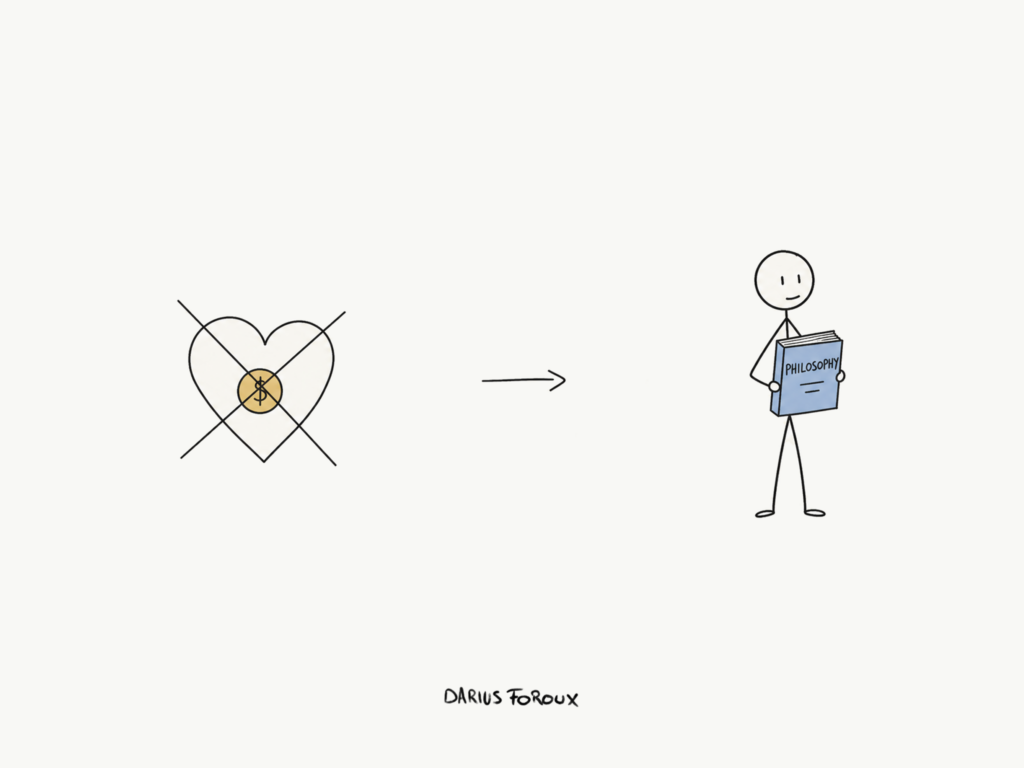
I gave up chasing money.
I started writing without any expectations, just because I loved ideas and wanted to think more clearly.
That decision changed the entire direction of my life.
What I actually learned
The Stoics didn’t tell me to want money less. They told me to look at where my wanting came from. And once you look at that honestly, the obsession loses its grip.
It stops feeling like ambition and starts feeling like fear wearing a suit.
One of the most profound and deepest ideas I’ve read comes from Epictetus. The following quote is from A Manual for Living:
“Open your eyes: See things for what they really are, thereby sparing yourself the pain of false attachments and avoidable devastation.”
Let me break that down, because there’s a lot in it.
- Open your eyes: Most of us go through life following others without questioning it. We absorb the values of the culture around us and call them our own.
- See things for what they really are: Look underneath the surface. What actually drives people. What they want underneath what they say they want. What you find, if you look honestly, is that a lot of what we chase is performance. We want to look successful more than we want to be successful.
- Thereby sparing yourself the pain of false attachments and avoidable devastation: Once you see human nature clearly, you stop attaching yourself to things that can’t give you what you’re actually looking for. And you avoid a lot of pain that was completely avoidable.
What’s the biggest false attachment? That money will make you happy.
It won’t. Not on its own. Not above a certain point. And definitely not if it becomes the only thing you care about.
Money is not the enemy
I want to be clear about something. Wealth and money are not the same thing, and I’m not saying either one doesn’t matter.
Money buys freedom, options, and security. Pretending otherwise is just another way to lie to yourself.
What changed for me is the relationship.
Seneca, one of the wealthiest men in ancient Rome, described it better than anyone I’ve read. He wrote:
“He does not love riches, but prefers them; he does not receive them into his heart, but into his house.”
Seneca was honest. He preferred wealth, because who doesn’t? Anyone who claims otherwise is lying.
We’d rather have a lot of money than not at all. But Seneca keeps it outside the part of him that actually matters.
The money lives in the house. Not in the heart.
That’s the whole shift.
You don’t have to hate money to stop being controlled by it. You just have to put it in the right room.
I don’t care about appearances anymore. What I care about now is depth, good work, and the people in my life.
And the money?
It follows. Not always immediately, and also not always in the way you expected. But it follows.
Philosophy didn’t make me poorer. It made me free. And that turned out to be worth more than any number I ever chased.